
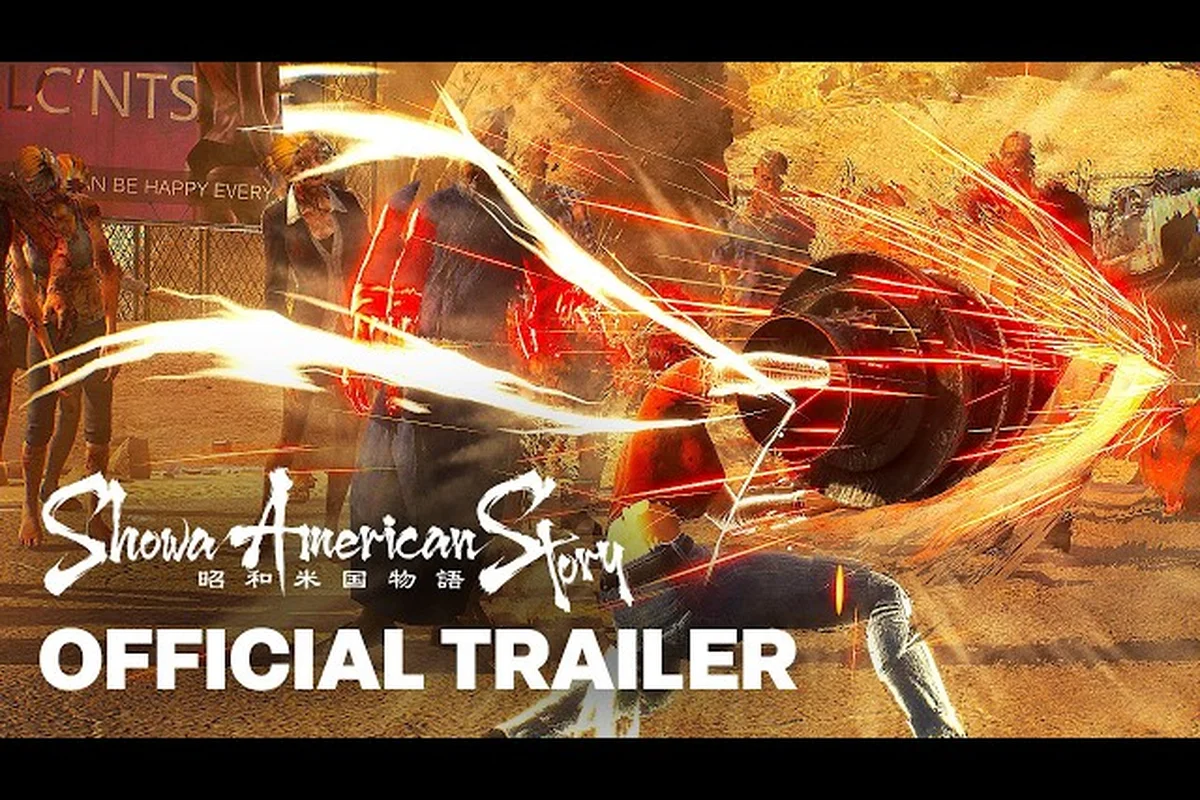
The Showa American Story plot summary follows Chigusa Choko, a teenage stuntwoman assassinated at Neo Yokohama airport and mysteriously resurrected in a zombie-infested America where Japan’s cultural colonization has reshaped society. This revenge road trip blends B‑movie aesthetics with emotional family drama, making the story essential for understanding the game’s unique alternate history premise and the stakes behind every bullet and blade.
The Showa 66 Era: How Japan Bought America
The Showa 66 era serves as the historical pivot for the entire Showa American Story plot summary. In this timeline, Japan’s economic dominance of the 1980s escalated into outright ownership of the United States. The official Steam description confirms that “a dominant Japan culturally colonized America” by the late 1980s, replacing American landmarks with neon kanji signs, converting diners into ramen joints, and imposing a hybrid samurai‑cowboy culture. This alternate history explained in the game’s opening cutscene shows the Catastrophe – a mysterious event that unleashed a zombie horde – wiping out most of the old government structures. Japan’s Showa dynasty, extending past its historical 64‑year reign into an imagined Showa 66, now controls everything from law enforcement to entertainment. The Zombie Human Rights Association emerges as a controversial faction advocating for undead civil rights, while the Texas Governor Boss Gokou rules with a mix of American six‑shooters and Japanese katanas.
This timeline explained in the game’s lore creates a world where players must navigate not only zombie threats but also the social tension between the surviving American resistance and the occupying Japanese authorities. According to the official NEKCOM game page, the setting is a “love letter to 80s pop culture with a strong taste of B-Movies,” which means every diner, gas station, and highway carries traces of both nations’ aesthetics. The Neo Yokohama city hub exemplifies this fusion: a rebuilt version of Los Angeles renamed in honor of Japan’s new capital, complete with arcades blaring enka music and vending machines selling bath salts that double as healing items.
Choko’s Resurrection and the Revenge Mission
The Showa American Story story explained through its protagonist begins with a brutal assassination. Chigusa Choko, voiced by Yoko Hikasa (as confirmed by the Gamescom 2026 trailer), is a stuntwoman who dreams of becoming a movie star. At Neo Yokohama airport, she is gunned down by unknown agents – the event that triggers the revenge plot. Players wake up as Choko, resurrected in a morgue with no memory of who killed her or why. A mysterious voice guides her to survive, and she soon learns that her younger sister Aya has been abducted by Boss Gokou’s organization.
The revenge trip takes Choko across the American wasteland in her customizable camper van, the Guren, which serves as both a mobile base and a symbol of her determination. The community reports suggest that the story’s emotional core revolves around Choko’s transformation from a naive stunt double into a ruthless fighter. She wields katanas, drills, and polearms, with each weapon’s moveset reflecting her stuntwoman background – acrobatic flips, slow‑motion finishers, and environmental takedowns. For players interested in the deeper lore behind Choko’s personal history, the who-killed-choko-in-showa-american-story guide provides a focused breakdown of the assassination mystery.
The plot thickens when Choko encounters the Zombie Human Rights Association, a group that believes the undead deserve legal protections and equal treatment. Their leader, Professor H, argues that the zombie outbreak is a natural evolution rather than a curse. Choko can choose to side with them or oppose their ideology, which affects the story’s branching paths. This narrative flexibility adds replay value, as each playthrough may reveal different cutscenes and NPC interactions depending on Choko’s moral choices.
Key Story Beats Across Zombie America
Economic Colonization Through Showa 66 Bonds and Infrastructure Acquisition
Under the Showa 66 policy, Japan’s government issued low-interest bonds to acquire strategic American assets—railroads, power grids, and stadiums—turning them into Showa-branded facilities. In-game, this is visible in cities where neon signs mix Japanese kanji with English, and former U.S. landmarks like the Texas State Capitol are repurposed as governor Gokou’s administrative headquarters. Players can find lore notes detailing bond purchase records and protests suppressed by the Japanese-controlled police force.
The RV Camper as a Persistent Hub for Crafting and Rest
Choko’s retro-fitted RV is the only safe zone in Zombie America; it features a workbench for weapon crafting (e.g., converting baseball bats into spiked clubs), a radio that unlocks cassette-tape minigames, and a bed to restore HP after encounters. Unlike checkpoint saves, the camper persists across cities—fast traveling between the sandbox regions of San Antonio, Dallas, and the Gulf Coast. Upgrading its engine reduces fast-travel load times, a key efficiency advantage during late-game cross-country missions.
The Showa American Story plot summary unfolds across five major regions—each a direct consequence of Japan's purchase of America in the Showa 66 era. These zones, such as the industrial Rust Belt ruins and the militarized Pacific Coast enclave, reflect the fractured governance and cultural clash that define the alternate history. Every region not only gates specific story missions but also unlocks unique side content, like faction-aligned fetch quests or hidden lore terminals detailing the collapse. The table below outlines each act's central conflict, with Act I pitting the protagonist against the fanatical "Sunrise Reclamation Army" in the capital, while later acts escalate into a power struggle between the exiled U.S. government remnants and the Showa administration's puppet rulers—a conflict that directly ties into the showa american story ending explained in the final chapter.
| Act | Region | Key Event | Antagonist |
|---|---|---|---|
| 1 | Neo Yokohama | Choko’s assassination and resurrection; learning basic combat | Airport security goons |
| 2 | The Desert Highway | Guren upgrade quest; first encounter with Boss Gokou’s scouts | Boss Gokou’s Enforcers |
| 3 | The Rust Belt | Liberation of a survivor camp; meeting the Zombie Human Rights Association | Professor H (moral dilemma) |
| 4 | Texas Governor’s Palace | Infiltration to rescue Aya; final confrontation with Boss Gokou | Boss Gokou |
| 5 | The Catastrophe Site | Truth about the outbreak; final choice (revenge vs. redemption) | The True Mastermind |
Each act introduces new mechanics and story twists. In Act 3, Choko discovers that the Catastrophe may have been artificially triggered by corporate experiments tied to the Japanese occupation government. This revelation forces her to reconsider her alliance with the Zombie Human Rights Association, as Professor H might have secrets of his own. The game’s B-movie tone keeps the narrative lighthearted despite the dark themes, with cheesy one‑liners, over‑the‑top explosions, and a soundtrack that mixes kayokyoku (Japanese pop from the Showa era) with American rock.
As Choko travels deeper into enemy territory, she acquires legendary weapons like the Katana Mikazuki Munechika and Wolf Fang Vajra Claws, which are tied to specific story beats. The community reports indicate that the American Flag Spear – a polearm crafted from a flagpole – is a reward for completing Act 4’s optional boss, reinforcing the game’s patriotic themes twisted through a Japanese lens.
Major Factions and Antagonists in the Story
Governor Gokou: The Dual-Nature Boss Fight
Gokou, the Governor of Texas, is the game’s first major boss, blending cowboy revolver skills with samurai iaido techniques. His fight splits into two phases: long-range saloon-style shootouts, where players must use the environment’s cover, and a close-range katana phase requiring perfect dodge timing to avoid a one-hit-kill iai slash. Defeating him rewards the “Texan Samurai’s Blade,” a weapon that hybridizes a Western six-shooter’s range with a katana’s melee speed.
The Theme Song 'Sorega Daiji' as an Emotional Anchor
Composed by Dai, the theme song “Sorega Daiji” plays during the final credits and also appears as an unlockable cassette in Chapter 4, letting players customize the RV’s radio. The track blends ’80s synthwave with Japanese enka vocal inflections, mirroring the game’s cultural fusion. Its lyrics—about “finding what truly matters” after loss—directly foreshadow Choko’s decision to spare Governor Gokou’s daughter, a turning point in the revenge mission that subverts the typical B-movie gorefest.
Understanding the factions is critical to the Showa American Story plot summary, because each group—from the expansionist Showa military authority imposing the "Greater East Asia Co-Prosperity Sphere" on American soil, to the fragmented resistance cells like the Liberty Front and the opportunistic corporate syndicates that profit from occupation—pursues a radically different vision for America’s future. These clashing ideologies (totalitarian control vs. guerrilla liberation vs. economic exploitation) drive every major story beat, from betrayals within the resistance to the protagonist’s shifting allegiances, making faction dynamics the backbone of the narrative’s alternate-history conflict.
| Faction | Leader | Goal | Stance on Zombies |
|---|---|---|---|
| Japanese Colonial Government | Boss Gokou | Maintain control and suppress resistance | Exterminate undead |
| American Resistance | Commander Reyes | Restore pre‑Japanese rule | Use zombies as weapons |
| Zombie Human Rights Association | Professor H | Grant zombies legal human rights | Protect and study zombies |
| Cult of the Catastrophe | The Oracle | Worship the outbreak as divine punishment | Embrace zombies |
The Boss Gokou character epitomizes the game’s cultural blender: he wears a cowboy hat over a samurai helmet, dual‑wields a revolver and a katana, and commands a army of both human soldiers and zombified enforcers. According to the Wikipedia article, he is the Governor of Texas, “both American cowboy and Japanese samurai,” and he rules with an iron fist. The showa-american-story-factions-explained internal guide offers a closer look at how each faction’s ideology impacts Choko’s journey and the available side quests.
The Cult of the Catastrophe operates in the background, claiming the outbreak was a divine punishment for Japan’s colonization. They perform rituals to accelerate the zombie infection, hoping to bring about a new world order. Choko can infiltrate their hideouts to gather evidence about the True Mastermind behind the Catastrophe, leading to the game’s final twist.
The Ending Explained: The Final Confrontation
The Showa American Story ending explained centers on Choko’s choice after defeating Boss Gokou. She locates her sister Aya in a prison cell beneath the Texas Governor’s Palace, only to learn that Aya was not abducted by Gokou but willingly joined his organization to protect Choko from the True Mastermind – a Japanese corporate executive named Miyamoto-san who orchestrated the Catastrophe as a population‑control experiment. Aya reveals she has been working undercover to gather evidence.
In the final battle, players face Miyamoto-san in a laboratory deep beneath the Catastrophe Site. He has transformed into a grotesque bio‑mechanical chimera using stolen zombie biotechnology. The community reports indicate that the final phase requires players to use the Guren’s emergency‑eject system to crash into the lab, creating a climactic showdown reminiscent of 80s action movies. After defeating Miyamoto-san, Choko can either choose to expose the truth (leading to a hopeful ending where the American Resistance and Japanese reformists ally) or seek personal revenge by killing all corrupt officials (triggering a chaotic ending where Choko becomes a wandering outlaw). The Showa American Story story explained by the developers hints at a New Game+ option that unlocks a secret “true ending” if players collect all Arcane Data Logs hidden throughout the map.
The Timeline Explained: From Catastrophe to Revenge
The Showa American Story timeline explained below helps players place each plot point in chronological order, tracing the narrative from the Catastrophe that collapsed the United States through the establishment of the Neo-Showa regime during the Showa 66 era, then into the protagonist’s revenge arc triggered by the murder of their family—key milestones such as the sinking of the US Pacific Fleet, the Japanese corporate takeover of major cities like San Francisco, and the protagonist’s first encounter with the Man in the Hat mark critical turning points that explain cause-and-effect relationships between the alternate-history lore and personal stakes.
| Event | Date (in‑game) | Impact |
|---|---|---|
| Japanese economic collapse of US | 1985 | US becomes Japanese colony |
| The Catastrophe | 1987 | Zombie outbreak kills 80% of population |
| Choko’s assassination | 1988 (Autumn) | Protagonist dies and is resurrected |
| The Revenge Trip begins | 1988 (late Autumn) | Choko begins road trip in Guren |
| Confrontation with Gokou | 1989 (Spring) | Sister Aya revealed as undercover agent |
| Final battle with Miyamoto-san | 1989 (Summer) | Choko chooses ending |
The Catastrophe is not a random disaster – it was engineered by Miyamoto-san to cull the American population and make colonization easier. The zombie infection, originally a bioweapon developed by a rogue Japanese lab, mutated beyond control. This timeline explained in the game’s data logs shows that Choko’s own resurrection was an unintended side effect: she was injected with an experimental ReGen serum by a scientist who worked for the Japanese government but regretted his involvement. That scientist, Dr. Tanaka, becomes a recurring quest giver, providing Choko with story‑critical upgrades.
Frequently Asked Questions
How does the Showa American Story plot summary begin?
The game starts with 17‑year‑old Chigusa Choko being shot dead at Neo Yokohama airport during a movie audition. She wakes up in a morgue, revived by a mysterious serum, and must survive the zombie horde while uncovering who orchestrated her assassination.
What is the Showa 66 era in the game?
Showa 66 is an alternate timeline where Japan’s Showa period extended into 1991 (equivalent to the year 66 of the Showa calendar). During this era, Japan bought America through economic domination and cultural colonization, replacing English signs with Japanese and imposing a hybrid samurai‑cowboy society.
Does the Showa American Story ending explained have multiple outcomes?
Yes, after defeating Governor Gokou, you choose between hope (exposing the conspiracy to spark resistance) or revenge (killing officials, leaving a power vacuum). Collecting all hidden data logs unlocks New Game+, revealing the full alternate history behind the Showa 66 era.
Who is the main antagonist in the story?
The primary antagonist is Boss Gokou, the Japanese Governor of Texas who blends cowboy and samurai culture. However, the true mastermind behind the Catastrophe and Choko’s assassination is Miyamoto-san, a corporate executive who created the zombie virus to control the population.
How does Choko’s sister Aya fit into the revenge plot?
Aya wasn't kidnapped—she infiltrated Boss Gokou's faction undercover to protect Choko from the Texas governor's scheme. She gathers evidence against Miyamoto-san and guides Choko to the final boss location. This family redemption subplot adds emotional stakes to Choko's revenge mission across zombie-infested America under Japanese colonization.